Chemical Laboratory
Two departments — inorganic and organic — covering water and environmental analysis end to end: trace elements by plasma, and organic contaminants at trace and ultra-trace levels, producing data fit for regulatory, industrial and research use.
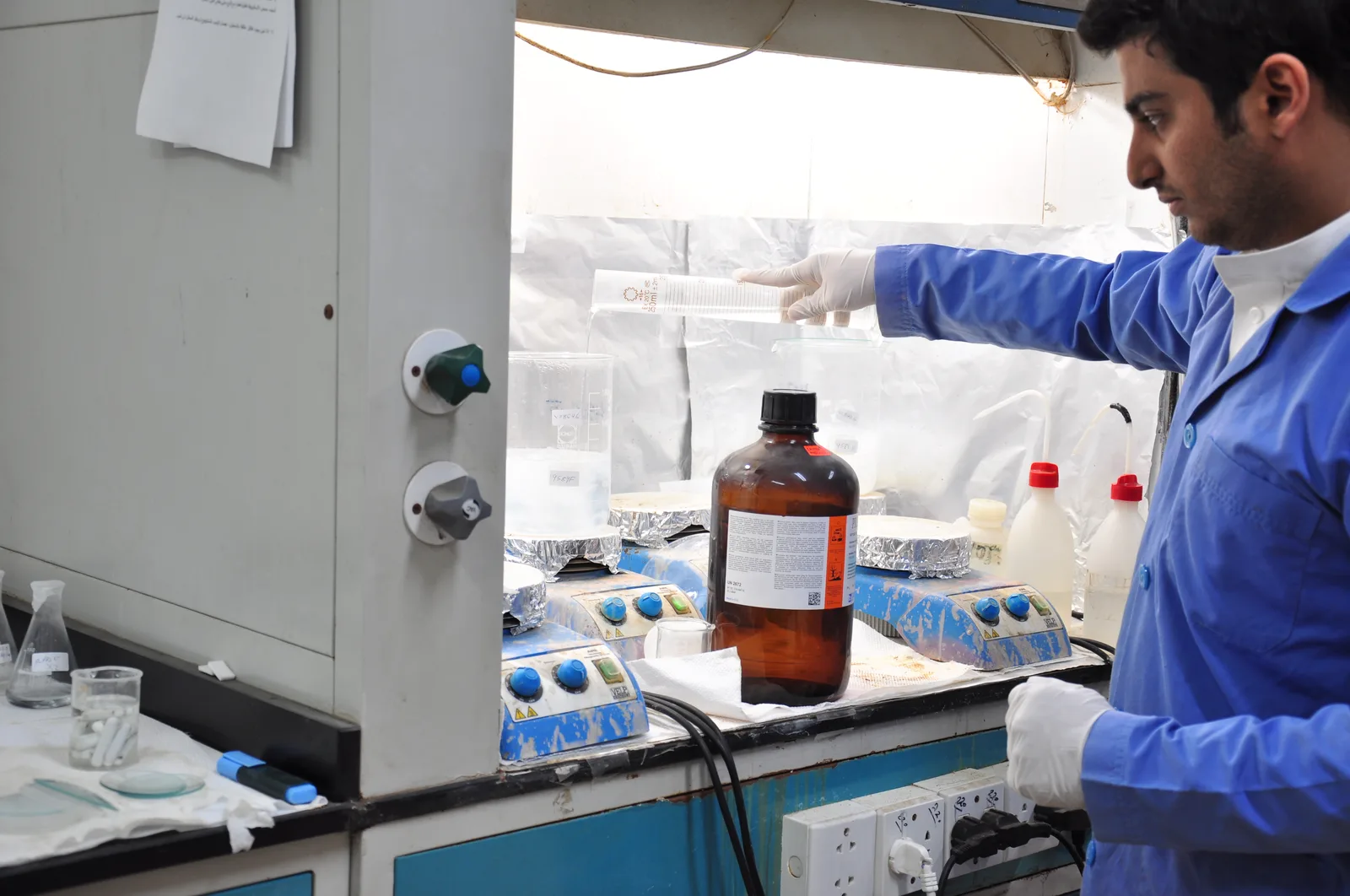
Analytical techniques
Elemental analysis by ICP
A high-temperature argon plasma atomises and excites the elements, so a wide range is measured simultaneously. ICP-OES reads the characteristic optical emission of the excited atoms and ions, suiting major, minor and trace elements from mg/L down to low µg/L.
Anions and cations by UV spectrophotometry
Nitrate, nitrite, sulphate, phosphate, fluoride, chloride, COD and TSS, plus ammonium and iron — by converting the analyte into a stable coloured complex or by direct absorbance.
Oxides by WDXRF
Wavelength-dispersive X-ray fluorescence for geological, mineral, cement, ceramic and environmental solids: SiO₂, Al₂O₃, Fe₂O₃, CaO, MgO, Na₂O, K₂O, TiO₂, MnO, P₂O₅ and SO₃.
Organics by GC-MS/MS and LC-MS/MS
GC-MS/MS measures volatile and semi-volatile organics through Purge-and-Trap, Headspace and Split/Splitless introduction, identifying a compound by its retention time and then by Single Ion Monitoring. LC-MS/MS measures heavier organics and some pesticides by Multiple Reaction Monitoring.
Sample preparation methods
Four-acid digestion (4AD)
A sequence of nitric, perchloric and hydrofluoric acids with a final hydrochloric dissolution, for near-total decomposition and multi-element analysis.
Borate fusion
For refractory minerals such as zircon, sphene, monazite, chromite and gahnite, and suited to rare earth and high-field-strength elements.
Fire assay
In NiS and lead forms: platinum-group elements are extracted by reductive fusion at 1100°C and collected in a lead capsule, then heated at 950°C to recover silver, gold, platinum and palladium.
Sodium peroxide fusion
With an Na₂O₂ flux, suited to samples high in sulphides, carbonaceous material or reduced mineral phases.
Aqua regia
A 1:3 nitric-to-hydrochloric mixture targeting metal sulphides, sulphates, carbonates, phosphates, PGEs, tellurides, selenides and arsenides.
Bulk leach extractable gold (BLEG)
Cyanide leaching to dissolve gold from a large sample into a 0.1–0.25% NaCN solution, reaching detection limits down to 0.1 ppb.
Our other laboratories
Sample analysis enquiries
Contact us regarding the sample type, the target elements and the appropriate preparation method.
Contact our team